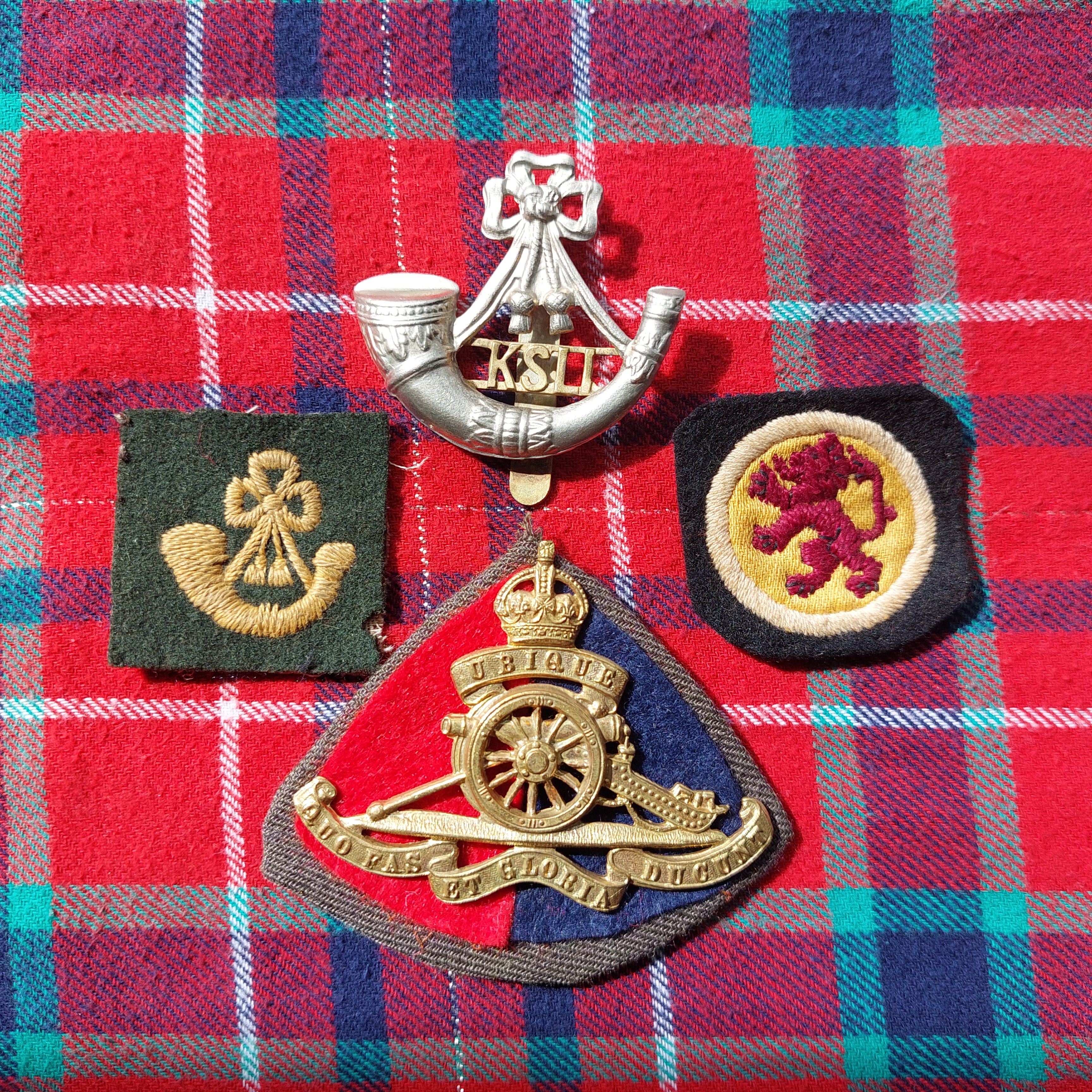
D-Day + 6, from Normandy to the Baltic Coast with the 15th Scottish Division.
Operation Overlord – D-Day. After a 24-hour postponement, on the 6th of June 1944 the long-anticipated invasion of Europe
was under way. Everything the men had been training for over the previous four years would be put to the test. These were
different men to those who had joined up in 1940, their military training had turned them into fighting soldiers they had become
proud gunners, a ready to go Royal Artillery field regiment, embedded in the 15th Scottish division with a proud tradition,
already carved by the Scottish divisions of the Great War.
On 22nd April 1944 the regiment moved to Worthing, the three artillery regiments were stationed between Ashington, Worthing and Lancing. The men were kept occupied with sport, boxing, football (of course) and greyhound meetings were held at Brighton. On the morning of the 6th the men watched in astonishment as wave after wave of aircraft passed overhead, the invasion had begun! A couple of nights later the regiment moved closer to Tilbury Docks, on the 10th of June they were on their way to the docks, Charlie Spence recalled “It was a wonderful journey, the streets were heaving with cheering crowds, the housewives passing us sandwiches and the men handing up bottles of beer”.
The division was scheduled to sail on D+6 June 12th. The weather in the Channel was very stormy making re-supply difficult.
Eventually the Division was loaded aboard, and the men made themselves as comfortable as possible for the crossing, the
gunners alongside their guns. By the 15th June the Division was anchored off the French coast at Arromanche and the unloading began almost immediately. The sea had turned very rough making the operation very dangerous. Only half of the Regiment was off their ship
before the weather halted the landing operation, one of the landing craft- a Rhino, fully loaded was smashed adrift and H.Q.
and half of 177 battery was lost at sea. The men had to scramble down nets into their landing craft, a terrifying experience as
the sea tossed the small craft in the air and then dropped it into a trough, the timing had to be spot on, It was 21st June before all of the 181st field regiment was on terra firma, they concentrated at Brecy, while 177 battery waited for replacement guns and equipment.
Eventually the regiment formed a convoy and made its way to the first gun position, and to war! During this move Lt. Philip Mulholland recalled their first casualty – Signaller Sgt. Bentley ran into the back of a lorry on his motorbike, and was reportedly on his way back to blighty before the opening shots were fired. The first troops into battle had already secured a tenuous bridgehead and were making
steady progress in land. The 15th Scottish moved to their forming-up area, 178 battery was formed- up in a small village called
Brouay, about 10 miles inland, the gun position was in an orchard behind Brouay church, a Commonwealth War Cemetery now
stands on this very site. On the 25th June whilst waiting for orders for battle to commence, Operation ‘Epsom’ one of the guns took a direct hit! three men were killed and three seriously wounded, a shocking start for C troop! But the gun was soon replaced and the
soldiers’ professionalism kicked in as they quickly pulled themselves together, while the wounded were tended to, and the dead buried in temporary graves
The 15(S) division drove forward helping to clear enemy troops from Normandy, at one point advancing without flank
protection, forcing what has been termed, ‘The Scottish Corridor’ to capture an important bridge over the River Odon. By August
1944 the Battle for Normandy was over, the Allied Army had held onto the beaches and driven the German army out of France. What
remained of that army was now fleeing for the River Seine in order to re-group and take up defensive positions further into
Belgium and Holland. 181 field regiment was the first field artillery across the Seine on 27th August 1944. The Allied army
continued to press the enemy and drove them hard out of Belgium, where the Division fought a short, but hard and costly battle
at a place called Gheel, The Divisional history recorded this tribute – ‘No praise can do justice to the work carried out by our
guns in this bridgehead fighting. Their fire was directed by a band of intrepid forward observation officers from 181 field
regiment‘. 3 Military crosses, 3 Military Medals and The Distinguished Service Order was awarded to the Regiment for this
action.
By this time winter weather was setting in and the 15(S) division were held up on the River Maas in Holland, this gave the
German army time to regroup and prepare defences on the German side of the river. After an intense artillery bombardment,
when the regiment fired over 4,000 shells, once again, 181 were the first field regiment across the River Maas, where
preparations were now being made for crossing of the River Rhine, the last major obstacle before crossing into Germany. This
commenced in March 1945 and on the afternoon of the 25th with Captain John Meredith in command of Charlie troop – the lead
troop, 181 field regiment crossed the Rhine to support the Divisional infantry, who quickly linked up with the men of the 6th
British Airborne and 17th U.S. Airborne Divisions who had parachuted behind German defences just a few hours earlier. There
was much fighting still to be done, but the allies were sweeping through Germany without compassion, as the Nazis refused to surrender although the war was all but lost. On April 8th May 1945 the German army surrendered, and the Regiment of Shropshire gunners who had been formed as the 6th battalion King’s Shropshire Light Infantry back in September 1940 were left to help take surrender of the German Navy on the Kiel Canal and help repatriate displaced persons and prisoners of war. In January 1946, with all the guns returned to
Ordnance and most of the men were re-posted or de-mobbed. In January 1946 the 181st field regiment was finally wound up and consigned to the pages of history.

C Troop 178 Bty – Rear: Sgt Fletcher; Bdr Rowlands; Gnr Parsons; Bdr.Mottram; Gnr Braithwaite. Front: Gnr Tommy Balcombe; Gnr Alf Abbiss
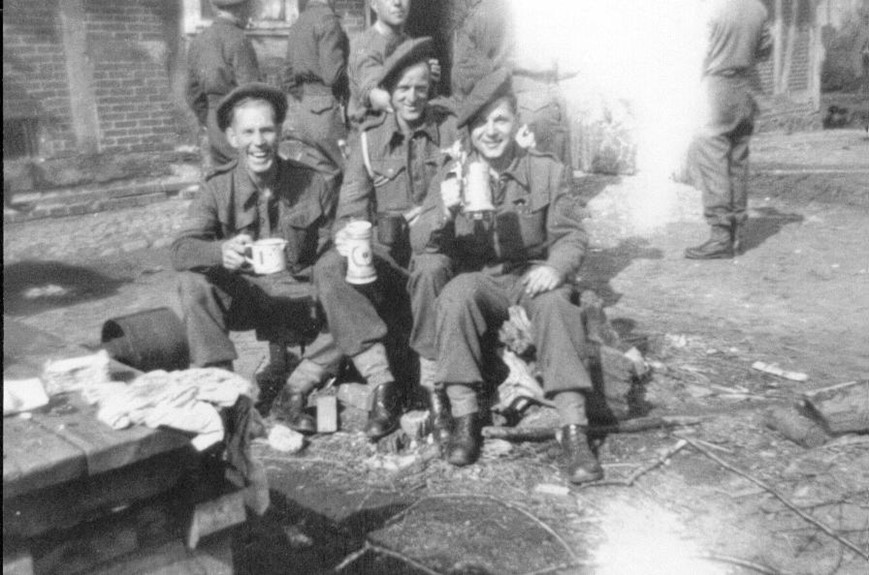
Somewhere in Holland – Sgt Dick Fletcher (4031603); Sgt George Gibbons (4037270); Bdr Mottram (4040568). Standing in the background Gnr Russell. All the NCO’s were ex KSLI.

This looks like an observation post (OP) crew, the Officer on the extreme right(LT David Small) carries a fine pair of binoculars, as they pose in front of a Bren Carrier. Note the soldier next to him with the accordion. Probably men from 179 Bty.
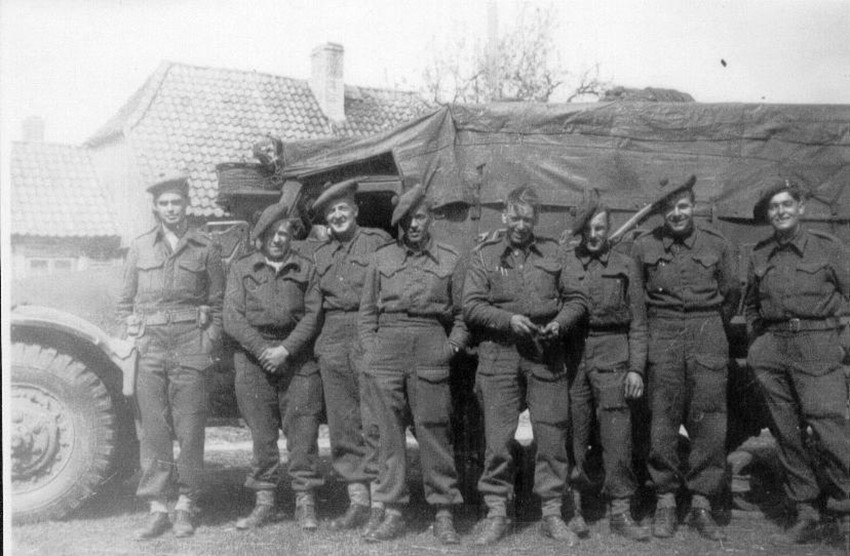
L-R: i/c Major James Robertson; L/Bdr Howarth; Gnr/Sig Bob Moore; Gnr Wain U/K; U/K; Gnr/Sig David McNair; Bdr Dytham
This is the HQ team 179 Bty posing in front of their Half-Track HQ. Note Major Robertson’s side arm.

Command Post Team B Troop 177 Bty – L-R; Capt.TJ. Stokes; L/Bdr.Watts; Gnr’s. Holmes; Vincash; Jones; Palmer; Hambleton; Richardson. Carrying their mess kit, this group pose in front of their command post. Note, Vincash and Palmer carrying Sten guns, while the remainder carry their Lee Enfields, Capt Stokes wearing his side arm.
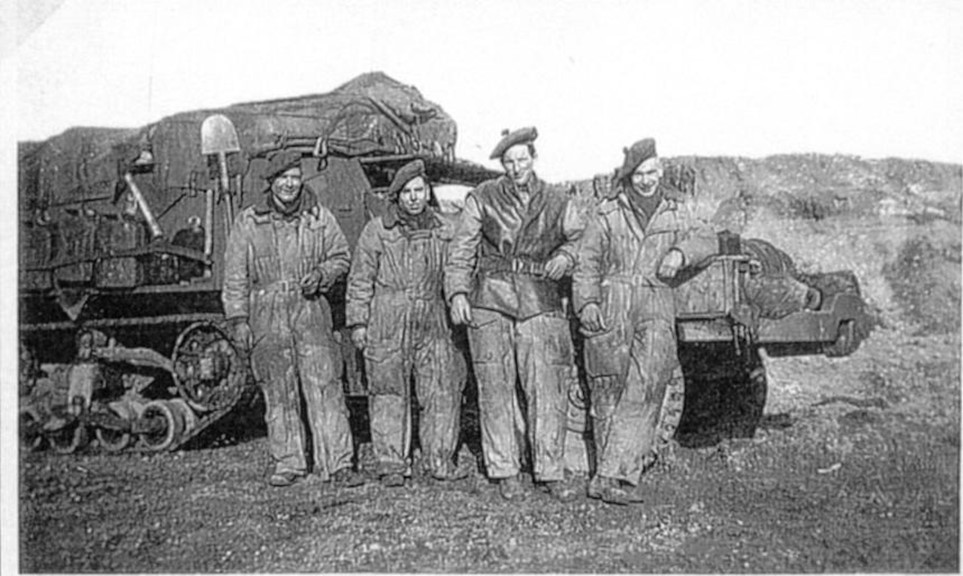
L-R; Gnr’s Ballymont; Coe; Temple; Goy. Forward Observation Post 177 Bty, waiting to cross the River Elbe April 19 dressed ready for work. These soldiers are kitted out in the overalls often worn by members of the Tank Regiments.

A fine group of NCO’s 177 Bty River Elbe, Germany March 1945. Jennings was awarded the Military Medal (MM) for exceptional service. L-R; Sgt Onions; Bdr Jennings; BSM Saunders; Sgt Edwards.

Somewhere in Holland 1944 NCO’s 178 Bty.
Rear L-R; L/Sgt Eden; BSM Cook; Sgt Layton; RSM Wright; Sgt Guy; BSM Oliver; Sgt Gibbons. Front; Sgt Foster; Sgt Fletcher; Sgt Shelby; Sgt Darby
L/Bdr Albert Smith; Gnr George Neal
A very special photograph. My Father at War!! An interesting but sad story surrounds this shot. During my research I had been in touch with Mr Bill Meredith, the son of Major John Meredith. Bill had given me a number for Albert Smith (L/Bdr Smith) who had been John’s Batman. Sadly, while this was going on Albert had a stroke from which he subsequently died before I made contact. I waited a respectful time and decided to write to his sisters enclosing a couple of super photos I had of Albert. They were thrilled and invited me down to Kent to have a look through Albert’s ‘things, which contained lots of photos’. I made my journey to Kent in May 1998, visiting Bill Smith and John May on the way. All three had transferred to 181 Field Regt along with 16 others from the Royal West Kents in 1943. As I went through Albert’s photos it dawned on me that he had joined the Territorial Army after the war and most of the photos related to this, my heart sank as I looked for a familiar face
And this photo popped up. The original was only 2”x2” but I was certain the tiny figure on the right was someone I knew. I turned the photo over, written on the back ‘George Neal and myself just outside Lauenburg’. What a scoop! here was my dad at war, looking every inch a fighting soldier, his gun was ready for action with the sights up and the platform in position. He and Albert must have been on the same gun crew, what tales he could have told me. They are not wearing their steel helmets so they are not expecting enemy fire, and these were the last days of the War what relief they must have felt. I used this photo on the front cover of my book.

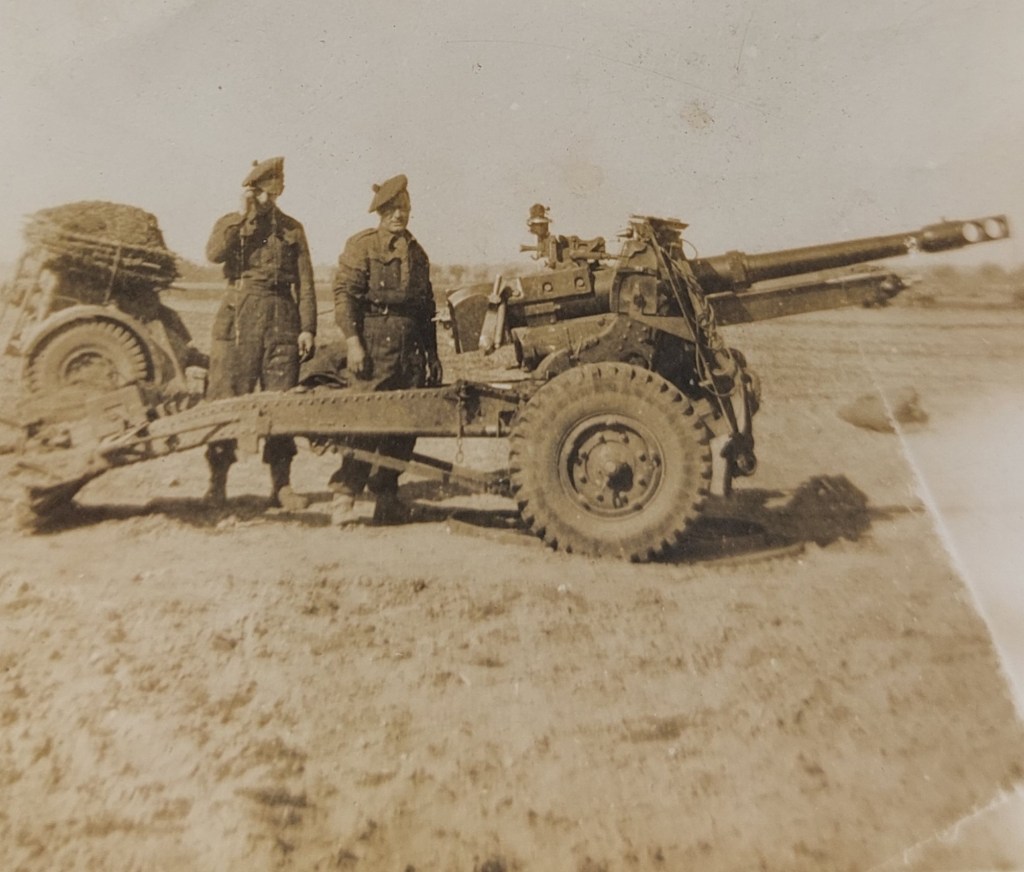
L-R Gnr Wall; U/K; Bdr Hyde; Sgt Guy. These men were from D Troop 178 Bty. The guns here too in ‘open position’

F/Grnd Sgt Telfer of 6KOSB Liases with his Forward Observation Post (FOP). B/Grnd; Gnr’s Mountford and Jenks. Note Sgt Telfer’s Sten Gun. He was to be awarded the Distinguished Conduct Medal for clearing German trenches with his Sten and Hand Grenades.
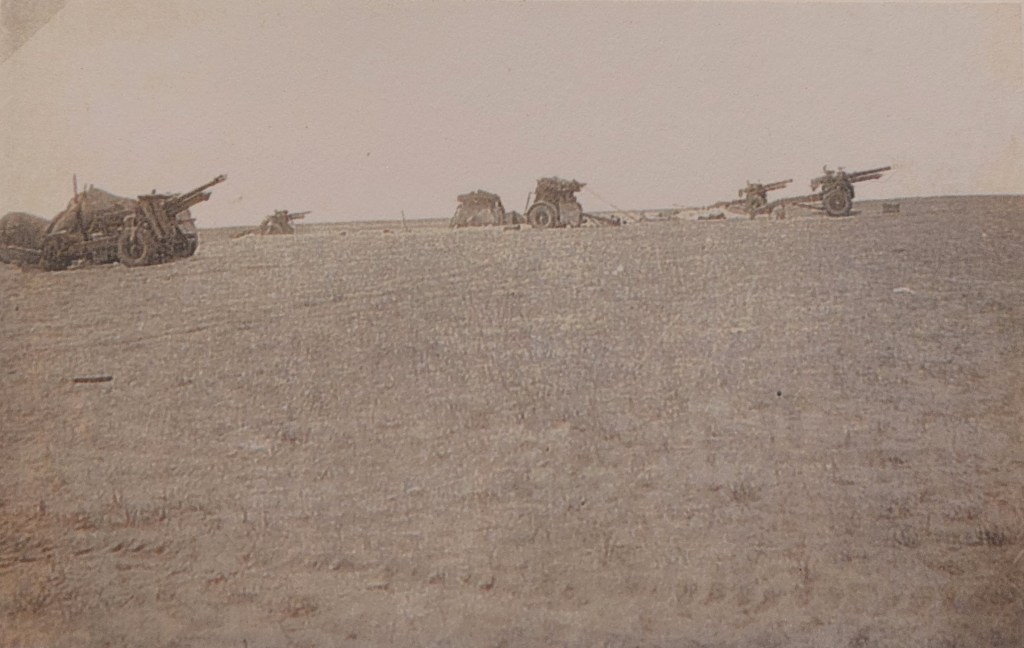
Guns in ‘open position’ positioned for action at Holdenstadt ready for the attack on Uelzen. These photographs were taken by Lt. Rod Gow a keen amateur photographer, after the fighting Rod held classes on photography to help keep the men occupied.

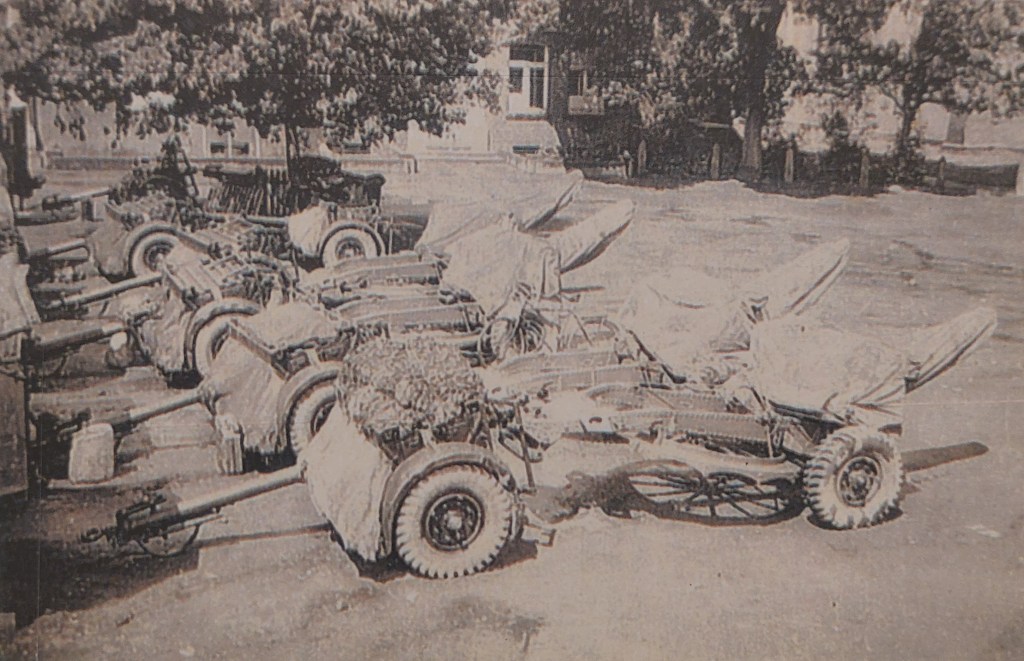
Guns and vehicles ready for the final push. Note the American star on the vehicles. Guns all serviced and prepped ready for action.
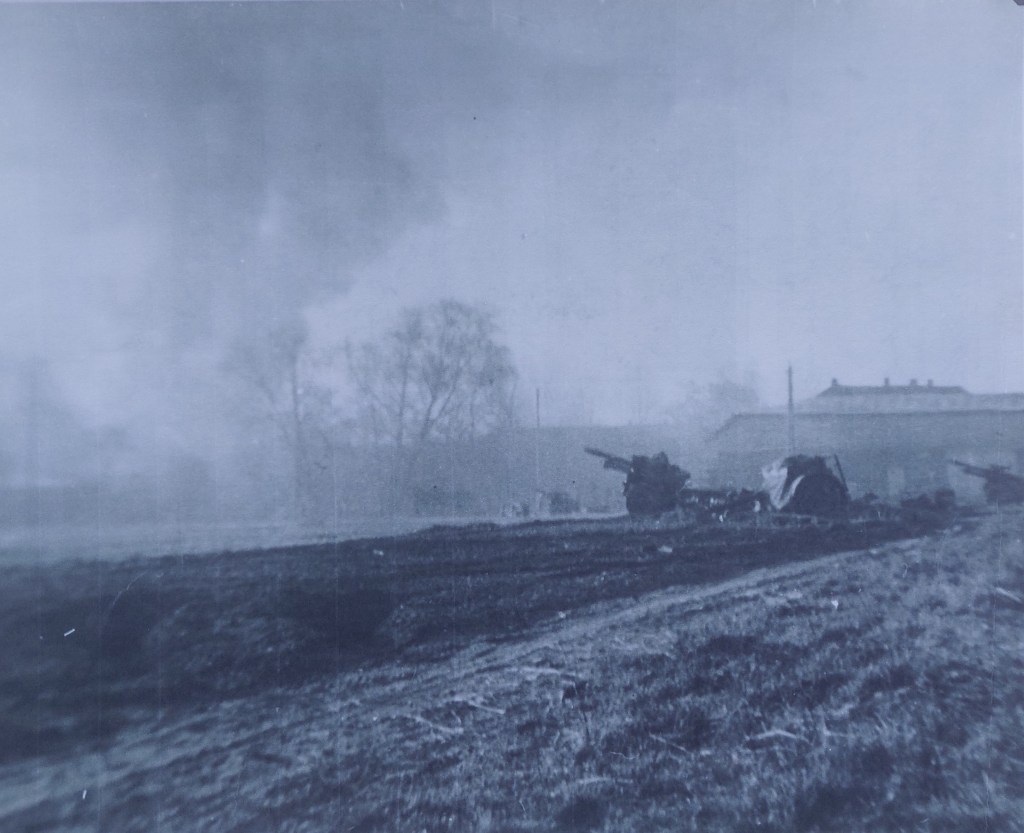
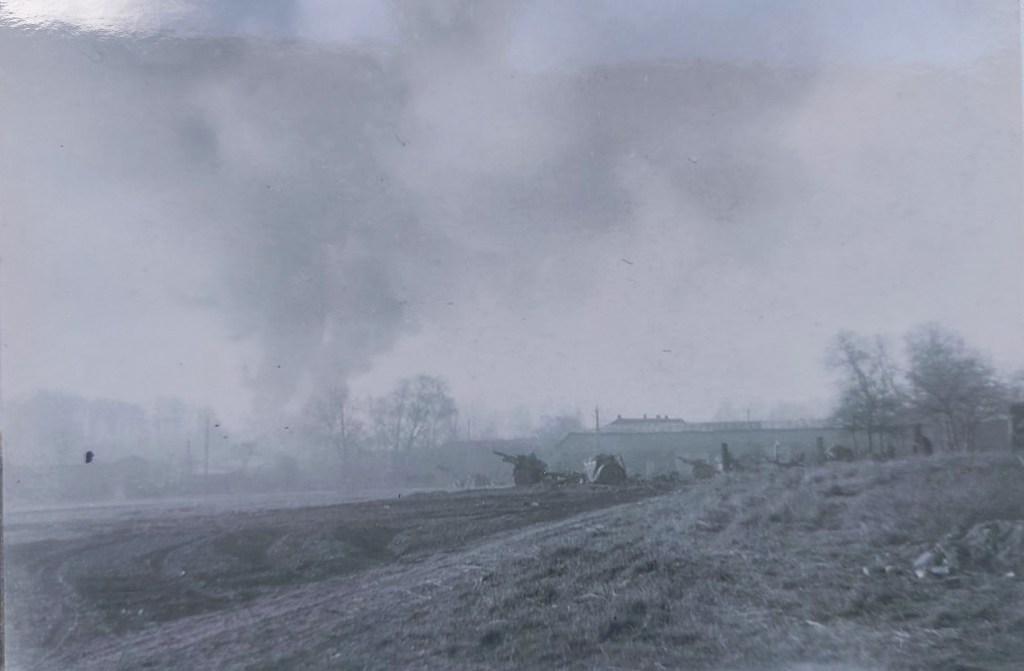
‘A’ troop 177 Bty in action Uelzen: Guns just fired. These two photographs were sent by Andrew Spearman, his father Bert can be see in the photo below in the middle of the track taking a compass bearing

‘A’ troop 177 Bty guns in action: Uelzen Between The Rhine & Elbe April 1945. The gun crew receiving instructions, on the left two officers stand outside troop H.Q. which could be anything, a building, a vehicle, a tent, even a hole in the ground.

25th March 1945, crossing the Rhine, winching ammo limbers out of the raft with quad winch. Officer on the right surveying the situation.

25th March 1945, digging gun pit, Vynen church in the background. BSM. Oliver with pipe, R-L L/Bdr Newall, Lt. Mitchell, Sgt Layton.
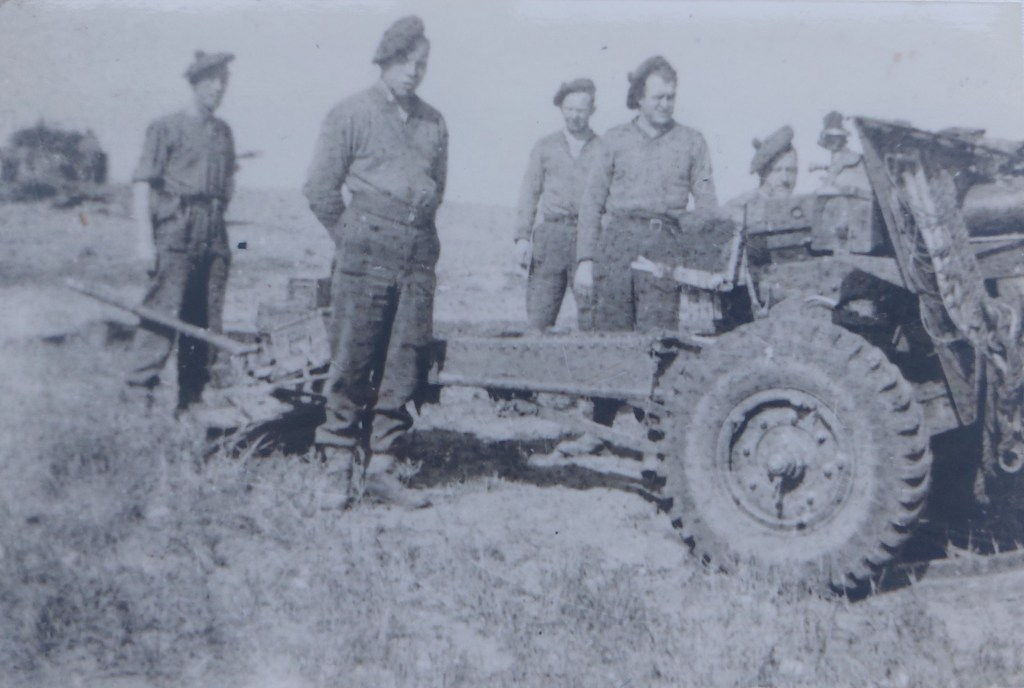
No2 Gun C” Troop 178 Bty. My Father is seated in the gun layers position. Bdr. Forknall on his right, Gnr. Braithwaite on his right, Sgt. Mottram in the foreground. A nice shot of the 25pounder sitting on the wheel that allows the gun to traverse, note gun sights. and tail jack, which allows the gun to be lifted and traversed. Two more photographs by Rod Gow – imagine his surprise when he found my old web site and seen his war time photographs, he told me that he photographed all the guns and crews of ‘C’

No3 Gun ‘C’ troop 178 Bty. Sgt Fletcher in the centre. Gnr Russel right. Another nice photo of the gun, note sights, and carrying case for the sights on the right.
Below : somewhere in Holland 1944be-freinding the locals. L-R Gnr. Scott, Gnr. Alf Russell, L/Sgt. Ted Edeen, Sgt. Mottram, Gnr.Tommy Balcombe, C.troop 178 Bty.


Rear:Gnr. Howarth: Major Robertson: L/Bdr.Wain: Gnr.Dytham. Front: Gnr.McNair: U/K: U/K . Forward observation post (FOP) team 179 Bty

Charles Bortrom – A Troop 177 Bty, Despatch rider, in the background is what looks like a casualty clearing station (CCS)
 Guns and Bugles